Beyond the Dev Team: Unlocking AI for Every Department
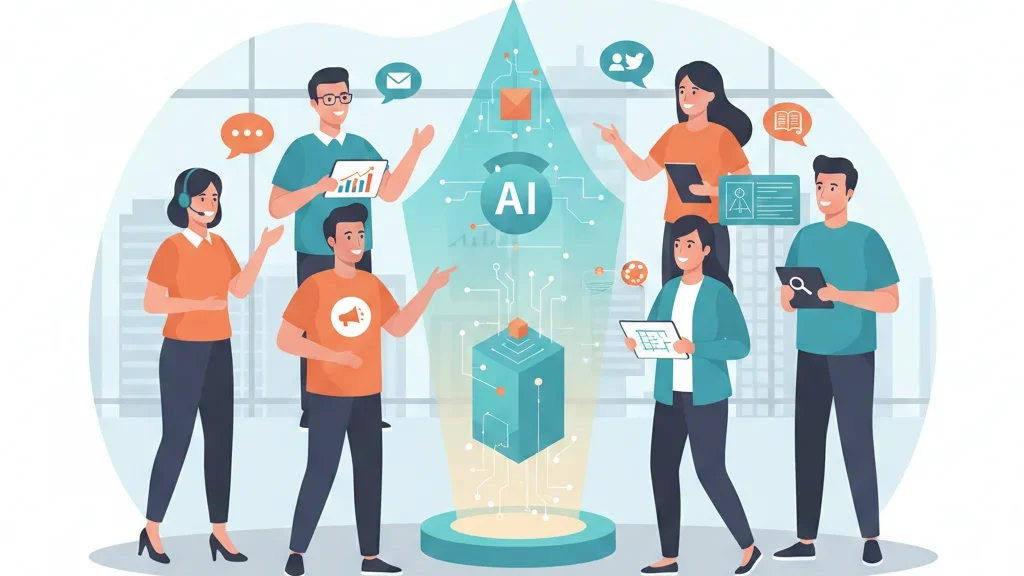
A quiet asymmetry has emerged in most organizations. Technical staff—developers, data scientists, DevOps engineers—have integrated AI tools deeply into their daily workflows. They use LLMs to debug code, generate documentation, explore solutions, and accelerate tasks that once took hours. Meanwhile, their non-technical colleagues in sales, marketing, HR, finance, and operations continue working the same way they did five years ago, unaware that the same tools could transform their effectiveness.
Throughout this article, “LLM” refers to large language models like Claude, ChatGPT, Gemini, and similar AI assistants.
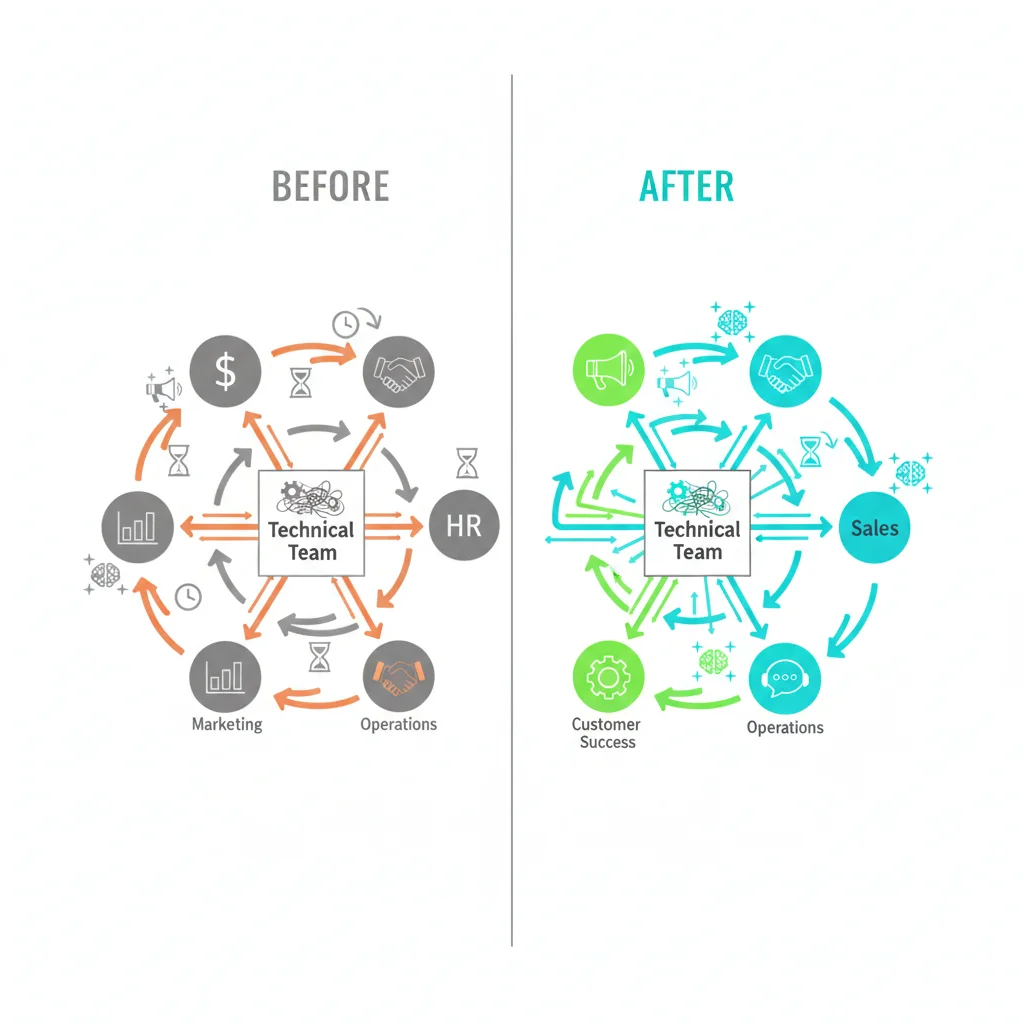
This gap represents both a problem and an opportunity. The problem: knowledge silos persist, information bottlenecks remain, and cross-functional collaboration suffers because only some teams have access to AI’s force-multiplying capabilities. The opportunity: organizations that democratize AI access across all departments gain compounding advantages that widen over time.
The Problem We’re Solving
Most organizations suffer from predictable friction points. Non-technical staff wait hours or days for answers that require technical context. Product managers can’t accurately scope features because understanding architectural complexity requires developer time. Sales teams write generic outreach because researching prospects thoroughly takes too long. Marketing produces content that technical reviewers must correct repeatedly. Customer success managers prepare QBRs based on gut feel rather than data analysis because extracting insights from usage metrics requires skills they don’t have.
These bottlenecks share a common characteristic: they exist because accessing certain information or performing certain analyses requires specialized knowledge or significant time investment. AI tools can bridge both gaps—providing instant access to specialized reasoning and compressing hours of research into minutes of interaction.
The knowledge silo problem compounds over time. Institutional knowledge accumulates in individual heads rather than accessible systems. When employees leave, their context leaves with them. New hires spend months building relationships just to learn who knows what. Cross-functional projects stall waiting for the right expert to become available.
Department-by-Department Use Cases
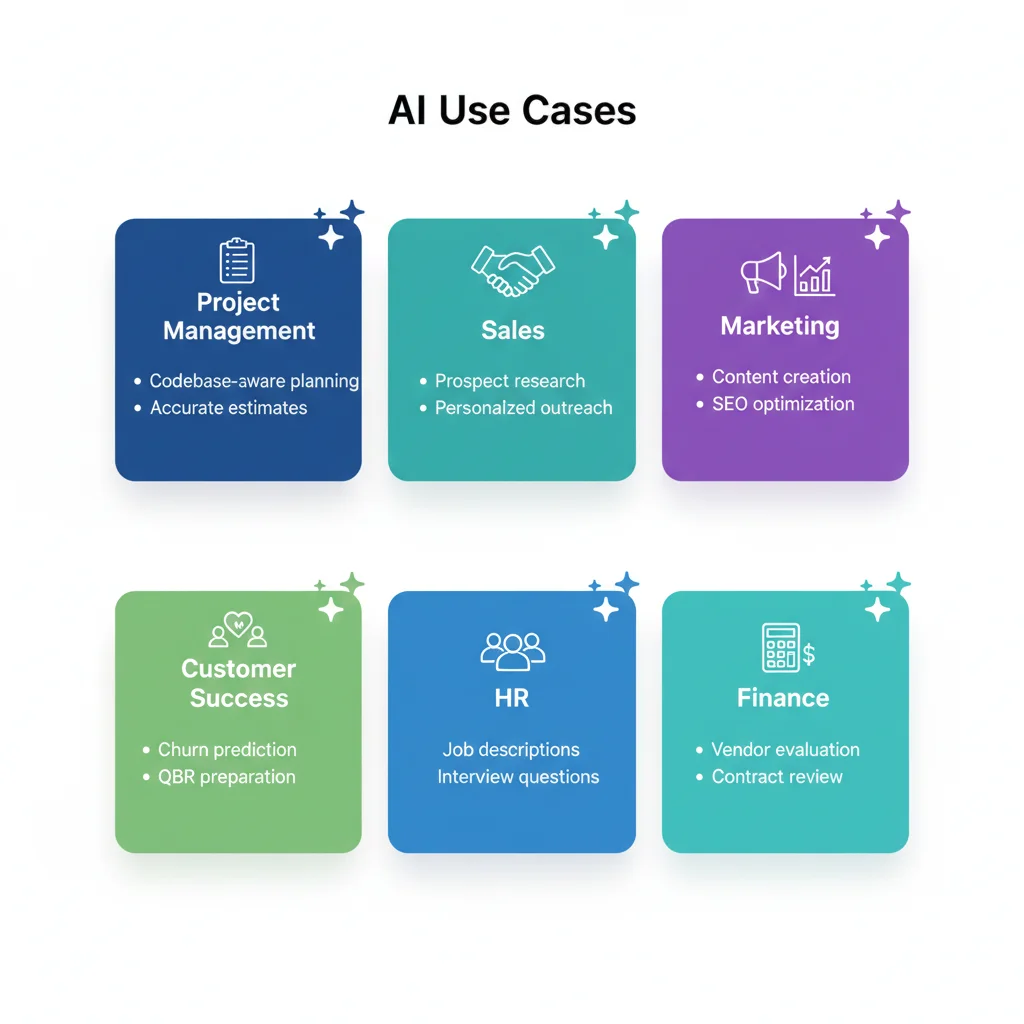
The abstract benefits become concrete when you see specific applications across different roles.
Project Management
Before: A PM needs to scope a feature involving payment integration. They message the tech lead, wait for a response, schedule a call, get a partial answer, then follow up with more questions spread across several days.
After: The PM opens an LLM with access to the codebase context. They ask: “What payment providers do we currently support? What would be involved in adding Stripe subscriptions? Which services would need to change?” Within minutes, they have architectural context, can identify dependencies, and create accurate tickets with realistic complexity estimates.
This shift doesn’t replace developer input for final decisions—it means PMs arrive at planning conversations already informed, making those conversations more productive for everyone.
Sales & Business Development
Before: An SDR prepares for outreach to fifty target accounts. They manually research each company, check LinkedIn, read recent news, try to identify pain points. Three hours later, they have superficial notes on maybe fifteen companies.
After: The SDR shares their target list with an LLM. “Research each company’s tech stack, recent funding, and likely pain points based on their industry and stage. Draft personalized first-touch emails that reference something specific to their situation.” The same task takes thirty minutes, with deeper research and genuinely tailored messaging.
Beyond prospecting, AI helps with competitive intelligence—analyzing competitor positioning, pricing, and feature gaps—and proposal generation, creating technically accurate sections without pulling engineers into the sales process.
Marketing
Before: The marketing team writes a blog post about a technical feature. They interview an engineer, draft content based on their notes, send it for technical review, receive corrections, revise, review again. The cycle takes two weeks.
After: Marketing uses an LLM to understand the feature directly—asking questions about how it works, what problems it solves, what makes the implementation interesting. They draft content that’s technically accurate from the start. Technical review becomes a sanity check rather than a rewrite.
AI also accelerates SEO work (keyword research, meta descriptions, content gap analysis), campaign ideation (brainstorming concepts based on product features and target audience), and analytics interpretation (helping non-technical marketers understand data and derive actionable insights).
Customer Success
Before: A CSM prepares a quarterly business review. They pull usage metrics from various dashboards, try to identify trends, and build a narrative based on intuition about what the numbers mean.
After: The CSM shares usage data with an LLM. “Analyze usage trends over the past quarter. Identify any patterns that suggest churn risk. What features are they using heavily versus ignoring? What expansion opportunities do you see based on their usage patterns?” The QBR becomes data-driven, with specific talking points backed by analysis rather than vague observations.
AI transforms customer success from reactive account management to proactive relationship development—identifying at-risk customers before they complain, spotting expansion opportunities based on usage patterns, and creating personalized onboarding paths based on customer segment.
HR & People Operations
Before: HR posts a job description for a senior backend role. It’s either too vague to attract qualified candidates or technically inaccurate because HR doesn’t fully understand the requirements.
After: HR works with an LLM: “Help me write a job description for a senior backend engineer. Our stack is Python, FastAPI, PostgreSQL, deployed on AWS. The role focuses on payment systems integration. What technical qualifications should we require versus prefer? What interview questions would effectively assess these skills?”
The result: accurate job descriptions that attract the right candidates, relevant interview questions, and better hiring outcomes—without requiring engineering time for routine recruiting tasks.
Finance & Operations
Before: Finance needs to evaluate three potential vendors for a new tool. They spend weeks gathering information, scheduling demos, and manually comparing features and pricing.
After: Finance uses an LLM to research each vendor’s positioning, typical pricing models, known limitations, and customer sentiment. They create comparison matrices covering features, pricing, security compliance, and integration capabilities. The same evaluation takes days instead of weeks, with more thorough analysis.
AI also accelerates contract review (identifying key terms and risks in vendor agreements), expense analysis (categorizing spending patterns and identifying anomalies), and process documentation (capturing and improving operational workflows).
The ROI Case
The benefits extend beyond individual productivity gains into organizational transformation.
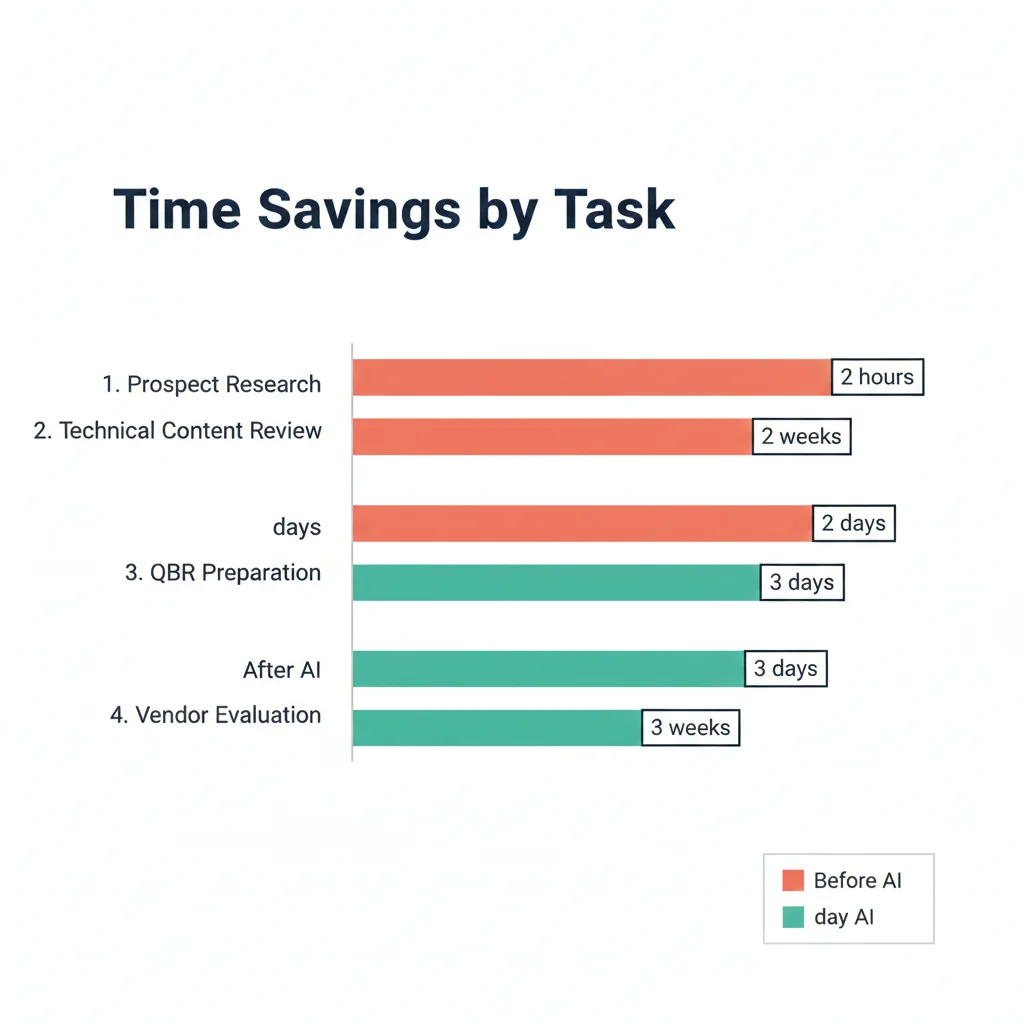
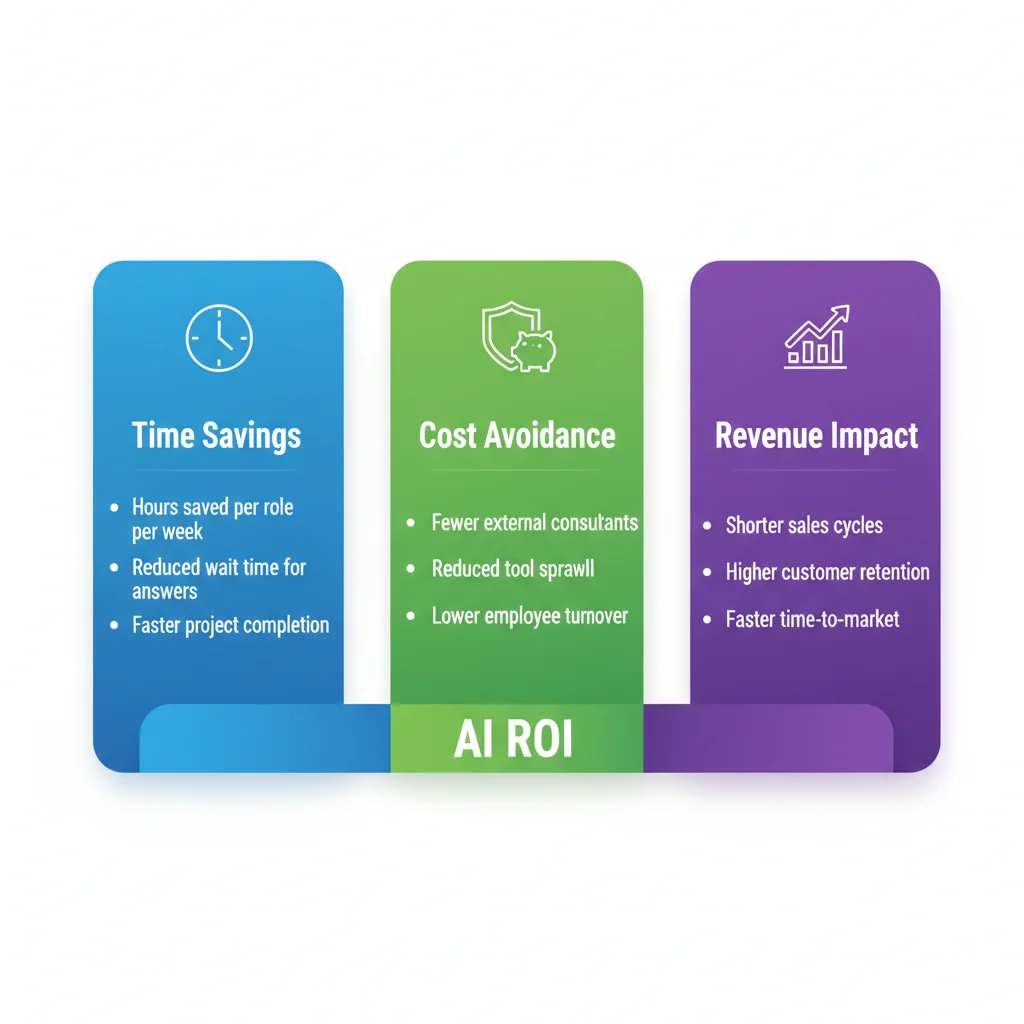
Time savings compound across roles. Project managers save 3-5 hours weekly by not waiting for technical answers. Sales representatives compress two hours of prospect research into twenty minutes. Marketing reduces content review cycles by 50%. Customer success managers prepare QBRs in hours rather than days. Across a hundred-person organization, these savings add up to thousands of hours annually.
Cost avoidance emerges from reduced dependencies. Fewer expensive consultants are needed when internal teams can perform preliminary analysis independently. Tool sprawl decreases when AI replaces multiple point solutions. Employee turnover drops when people feel empowered rather than blocked.
Revenue impact comes from faster execution. Sales cycles shorten when outreach is more personalized and follow-ups are more informed. Customer retention improves when success teams identify risks proactively. Time-to-market decreases when planning happens faster and cross-functional coordination improves.
To measure AI ROI specifically, track “time to answer” before and after adoption. Count reduced hand-offs between departments. Survey employee autonomy and satisfaction. These metrics capture whether AI is actually changing how work gets done versus just being another tool people ignore.
The Compounding Benefits
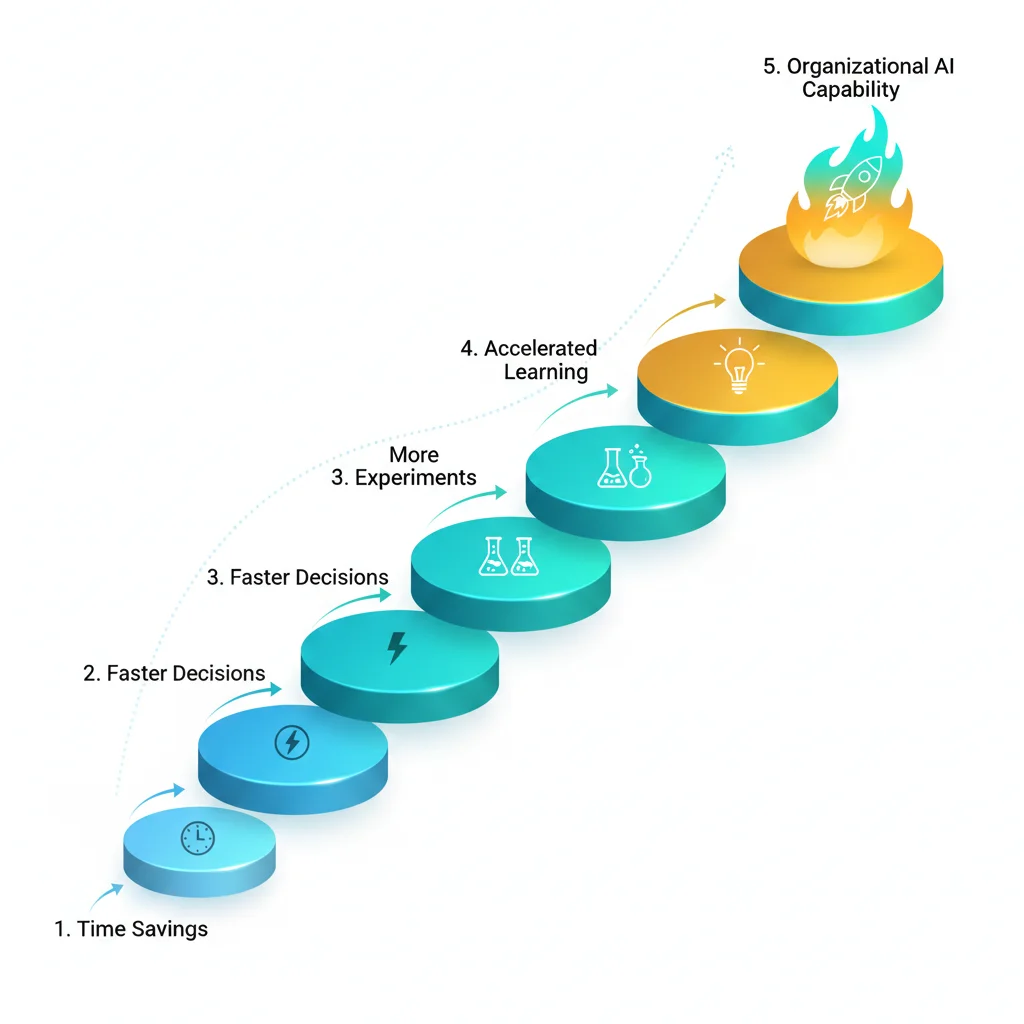
Individual time savings represent first-order effects. The deeper benefits compound over time.
Speed: Research that took hours takes minutes. Decisions that waited for “the right person” happen when they need to happen. The organizational clock runs faster.
Accuracy: Fewer misunderstandings between technical and non-technical teams. Better-informed decisions at every level. Reduced miscommunication and misaligned expectations.
Autonomy: Employees don’t wait for experts to become available. They investigate questions themselves, arriving at conversations already informed. Empowered employees accomplish more and complain less.
Memory: AI becomes organizational memory. Onboarding new employees accelerates because context is accessible, not locked in colleagues’ heads. Institutional knowledge persists even when individuals leave.
Alignment: A common language develops between technical and non-technical teams. The sales team understands product capabilities accurately. Marketing speaks about features correctly. Customer success knows what’s actually possible versus what’s on the roadmap.
Implementation Roadmap
Rolling out AI to non-technical teams requires deliberate effort. Moving too fast creates confusion and bad habits; moving too slowly cedes competitive advantage.
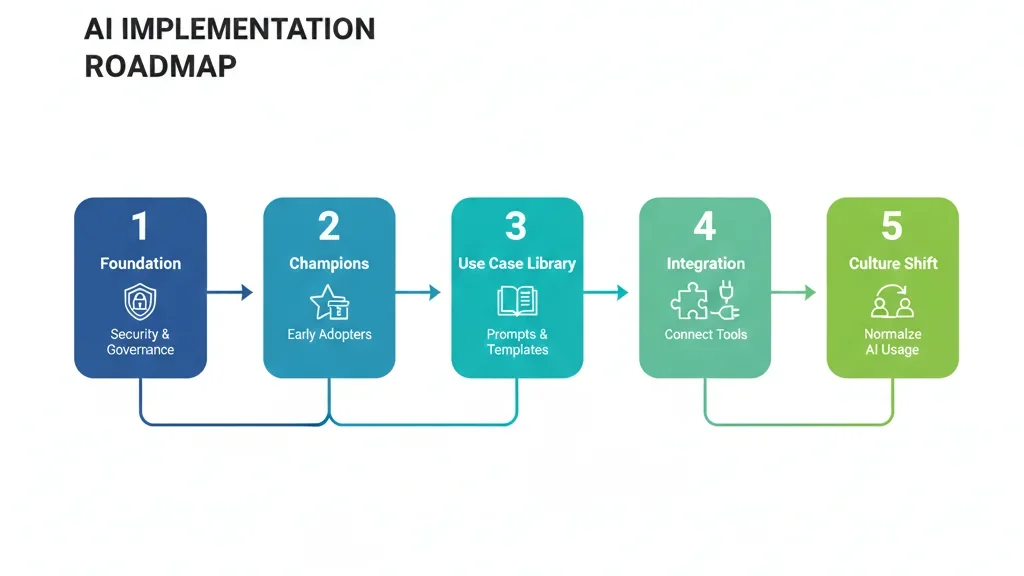
Phase 1: Foundation
Start with security and governance. Define what data can and cannot be shared with AI tools. Establish guidelines for handling sensitive information—customer data, financial details, competitive intelligence. Choose tools that meet your security requirements. This groundwork prevents the kinds of incidents that cause organizations to ban AI entirely.
Phase 2: Champions Program
Identify early adopters in each department—people curious about AI and willing to experiment. Provide them with training and support. Document their wins and use cases. These champions become internal evangelists and first-line support for their colleagues. Their enthusiasm and success stories drive organic adoption.
Phase 3: Use Case Library
Build an internal repository of effective prompts and workflows. Create templates for common tasks: prospect research, content outlines, contract review checklists, interview question generation. Share success stories that show concrete outcomes. This library accelerates adoption by giving newcomers proven starting points rather than blank pages.
Phase 4: Integration
Connect AI to existing tools where possible—CRM systems, document repositories, communication platforms. Build workflows that reduce friction between asking AI a question and acting on the answer. Measure adoption and outcomes systematically. Identify which use cases deliver the most value and double down on those.
Phase 5: Culture Shift
Make AI usage normal rather than exceptional. Celebrate efficiency gains publicly. Recognize people who find creative applications. Continuously evolve practices as capabilities improve and new use cases emerge. The goal is an organization where the question isn’t “should I use AI for this?” but “how can AI help me with this?”
Common Pitfalls
Organizations that struggle with AI adoption typically make predictable mistakes.
Over-reliance without verification: AI outputs require review. Sales emails should be read before sending. Contract analysis should be validated by someone who understands the business context. AI augments judgment; it doesn’t replace it. Organizations that treat AI outputs as gospel rather than drafts create risk.
Inappropriate data sharing: Without clear guidelines, employees will share things they shouldn’t—customer PII, confidential financials, competitive intelligence. Establish boundaries before broad rollout, not after the first incident.
Expecting AI to replace human judgment: AI accelerates research and analysis. It doesn’t make decisions. The PM still decides what to prioritize. The sales rep still chooses which prospects to pursue. The CSM still navigates difficult customer conversations. Organizations that expect AI to eliminate the need for expertise misunderstand the technology.
Rolling out too fast: Overwhelming employees with new tools and expectations creates backlash. Champions programs and gradual expansion work better than company-wide mandates.
Not measuring outcomes: Without metrics, AI initiatives become articles of faith rather than business investments. Track time savings, error reduction, and employee satisfaction to understand what’s actually working.
Getting Started
The path from “our non-technical teams don’t use AI” to “AI is embedded in every workflow” is long, but the first step is short. Pick one non-technical team. Identify one workflow that consumes significant time and could benefit from AI assistance. Run a pilot. Measure results. Learn what works.
The companies building competitive advantages aren’t waiting for perfect AI tools or comprehensive rollout plans. They’re experimenting now, learning what works for their specific context, and building organizational capability that compounds over time.
Your technical teams already know AI transforms how they work. It’s time your whole organization discovered the same thing.